The question with the least honest answers online
What fees am I actually paying?
Ask an exchange what it charges and you get one number. That number is real, and it is not what the purchase costs you. There are four separate deductions and the largest one for a beginner is usually the one with no name on it.
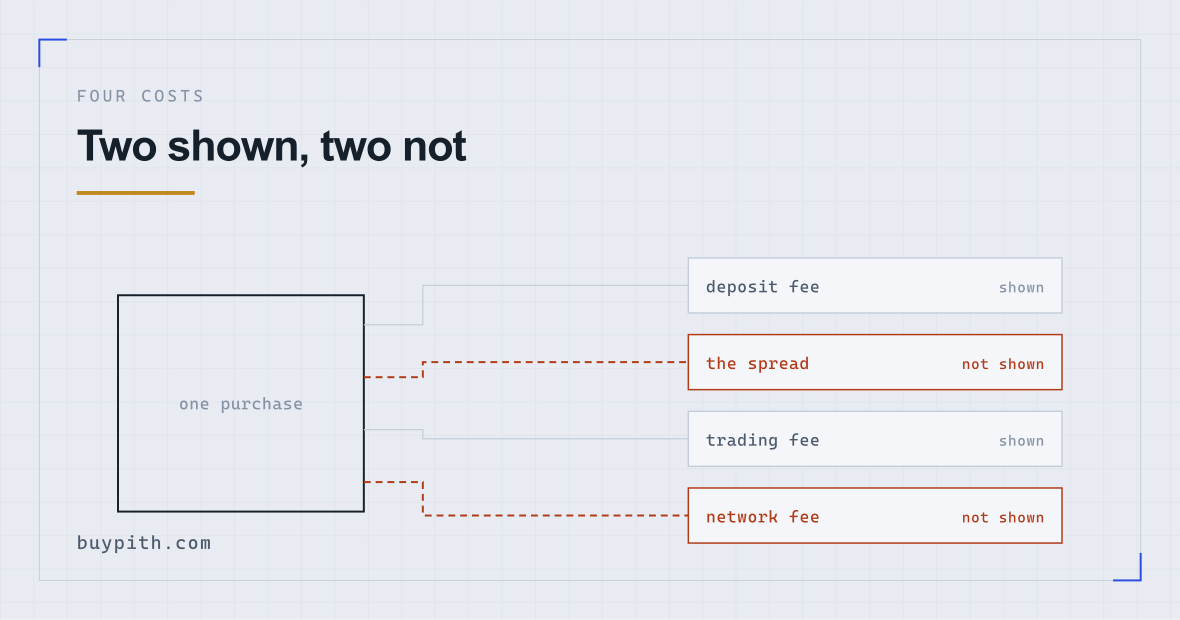
- Deposit fee — charged to get money onto the platform. Card has one; bank transfer often does not.
- Trading fee — a percentage taken by the exchange when the order fills. Shown as a line item.
- The spread — the gap between the price you are quoted and the real market price. Never shown, often the biggest.
- Network fee — only if you move coins off the platform. Fixed in size, so it punishes small holdings.
Exchange marketing quotes a trading fee, typically a fraction of a percent, and it sounds negligible. It is also, for a first-time buyer using the convenient interface, frequently the smallest of the four things taking money out of the purchase.
Here they are separated, with which ones are visible, which scale with size, and which do not.
The deposit fee — charged before you buy anything
Getting money onto the platform can cost money, and this is decided entirely by the route you choose. Card deposits carry a processing markup nearly everywhere. Bank transfers are frequently free.
This charge is usually partly fixed in effect, which is why it hurts small purchases disproportionately. A flat couple of dollars is nothing on a large deposit and a tenth of a very small one. The arithmetic on that is the single most useful thing on this site for anyone starting small.
Visible? Yes, on the deposit screen before you confirm. Avoidable? Largely, by using a bank transfer.
The trading fee — the one everyone quotes
A percentage of the order value, taken by the exchange when your order fills. It is the fee that appears in comparison tables, and the only one a referral code could bear on at all — whether any rebate on it reaches you is the exchange's setting, not a given.
Two things about it are worth knowing:
- Maker and taker rates differ. An order that sits in the book waiting (a maker) is typically charged less than one that fills immediately against existing orders (a taker). This is why the order type you choose has a cost consequence and not only a timing one.
- The rate is tiered by volume. The headline number applies to the lowest tier, which is where you are. Fee schedules are published — Binance publishes theirs here — and that page is the authority rather than any article.
Visible? Yes, as a line item on the confirmation. Scales with size? Yes, purely proportional.
The spread — the one with no name on your receipt
This is the cost that produces the confused searches, because nothing on the screen is labelled “spread” and yet money is unaccounted for.
At any moment there is a highest price someone will pay and a lowest price someone will sell at, and they are not the same number. The gap between them is the spread. When you buy, you cross it. A simplified “buy crypto” widget quotes you a single all-in price, and the difference between that price and the true mid-market price is a cost you have paid without seeing a fee.
Open the simplified buy widget and note the rate offered for your amount. Then open the full trading screen for the same pair and look at the current price. The gap between the two is what the convenience is costing you. Doing this once, before your second purchase, is more informative than any article on fees.
On a liquid pair like bitcoin against a major currency, the underlying market spread is genuinely thin. What is not thin is the markup a simplified widget can add on top of it, because that widget is a retail product priced for convenience rather than a market venue.
Visible? No. Avoidable? Substantially, by using the trading screen rather than the widget.
The network fee — only if you move the coins
Nothing above involves the blockchain. Buying on an exchange updates the exchange's own database; no transaction is broadcast anywhere. The network only becomes involved when you withdraw to a wallet you control.
At that point you pay a network fee, which Binance charges as a flat amount per network to cover the on-chain cost (paid to miners on bitcoin, to validators on proof-of-stake networks); the exchange sets the figure, so it is not literally the chain's fee passed through. Two properties make it behave differently from everything else here:
- It is essentially fixed per transaction, not proportional. Moving a small amount and a large amount costs roughly the same.
- It floats with demand. When a network is busy the fee rises for everyone. You can watch this happening in real time on a public explorer such as mempool.space.
Because it is fixed, it is brutal on small holdings — which is why exchanges impose a minimum withdrawal amount, and why that minimum is often much higher than the minimum purchase.
Visible? Yes, on the withdrawal screen. Scales with size? No, and that is the whole problem.
The fifth one: currency conversion
Strictly this is not a crypto fee at all, which is exactly why it goes uncounted. It applies to anyone whose bank account is not in the currency the platform quotes in.
If you deposit in one currency and trade against a pair denominated in another, a conversion happens somewhere. It might be your bank doing it on the card transaction, the exchange doing it on deposit, or you doing it deliberately by trading into the quote currency first. Each of those routes has a different cost, and the most expensive is usually the one that happens automatically without asking you.
The tell is a rate that differs from the one you can look up. Bank conversion on a card payment typically applies a margin over the interbank rate; some cards add an explicit foreign transaction fee on top. Neither appears on the exchange's screen, because neither is the exchange's charge.
What to do about it: find out which currency pair you are actually trading, and whether your deposit is being converted before it gets there. If it is, compare doing it yourself against letting it happen — on some platforms converting inside the exchange is materially cheaper than letting your bank do it at the card terminal, and on others it is not. This is one of the few places where five minutes of checking can save more than the trading fee costs.
Putting the four together
| Cost | Charged by | Shown as a fee? | Behaves like | How to reduce it |
|---|---|---|---|---|
| Deposit fee | Exchange / payment partner | Yes | Partly fixed | Use a bank transfer |
| Trading fee | Exchange | Yes | Percentage | Limit orders; a referral rebate only if the sign-up screen shows one |
| Spread | Nobody, structurally | No | Percentage, but variable | Trading screen, not the widget |
| Network fee | The blockchain | Yes | Fixed | Withdraw less often, in larger amounts |
The pattern that matters: the two costs that are hardest on a small first purchase are the two that do not scale — the fixed part of the deposit fee and the network fee. Both are absolute amounts being divided by a small number. The fee impact table shows how the total proportion changes as the purchase size grows, which is the clearest way to see why “you can start with $10” is technically true and practically misleading.
Why this page has no percentages in it
Deliberate, and worth explaining rather than looking evasive.
Every one of these rates varies by country, payment method, account tier, trading pair and network conditions, and they change without announcement. A number written here would be right for one reader on one day and quietly wrong for everyone after that. On a page about money, a stale number is worse than no number, because it looks authoritative.
What we can do instead is tell you where each one is displayed at the moment it applies to you:
- Deposit fee — deposit screen, after choosing method and currency.
- Trading fee — the order confirmation, and the published fee schedule for the underlying rate.
- Spread — nowhere, by construction. Compare the widget's quoted rate against the trading screen's price yourself.
- Network fee — withdrawal screen, after selecting the network. It changes between the moment you look and the moment you send.
Checked 2026-08: all four still appear at those points. The deposit screen layout differs by region.
If you want one concrete example rather than none, the fee impact table carries a dated snapshot of one platform's published rates — stamped with the day it was read, and with the same warning attached, because it will go stale too. Keeping the figures on one page, with a date on them, is what lets this page stay true for longer than a week.
Working out what a purchase actually cost you
There is a way to find the true all-in cost that does not require understanding any of the above, and it is worth doing once.
- Note the amount of ordinary money that left your bank account. Not the amount you typed on the exchange — the amount your bank statement shows, which already includes any card charge and any conversion your bank applied.
- Note the quantity of crypto that arrived in your balance.
- Look up the mid-market price of that asset at roughly the time you bought. Any public price source will do.
- Multiply the quantity by that price. That is what you received, valued honestly.
- Subtract that from what left your account. The difference is everything — fee, spread, card markup, conversion margin — in one number.
Divide that number by the amount you spent and you have the real cost as a percentage. It is frequently several times the headline trading fee, and seeing it once changes how people fund their second purchase more effectively than any amount of reading.
Nothing about this exercise is urgent for the first buy — the money is already spent. It matters because the funding route and interface you used the first time is the one most people keep using by default, and a single check tells you whether that default is costing you a fraction of a percent or several percent every time.
What this means for a first purchase
Three practical consequences, in order of how much money they represent:
- Fund by bank transfer if you are not in a hurry. This removes most of the fixed component, which is the biggest single item on a small purchase.
- Look at the trading screen at least once. Not to become a trader — to see the gap between its price and the widget's quote. That gap is a cost you are otherwise paying blind.
- Do not withdraw a very small holding. The network fee does not care that your balance is small, and moving $20 off a platform can cost a meaningful share of it.
None of this changes whether buying is a good idea. It changes how much of your money arrives as the thing you meant to buy, which is a different question and the only one on this page.
Questions people actually ask
Why did I receive less crypto than the amount I paid?
Because the fee is deducted from the purchase, and because the price you were quoted already included a spread. The confirmation screen shows the quantity you will actually receive; that figure, not the amount you typed, is what you should read before confirming.
Is the spread a fee?
Not in the sense of a charge someone levies — it is the structural gap between buying and selling prices in any market. But it costs you real money and it does not appear as a line item, so it is worth treating as a cost even though nothing labels it one.
Does a referral code reduce all of these?
No. A referral code can only ever bear on the exchange's trading fee, and Binance sets out no standing discount on it for the person signing up — any rebate is a setting, shown on the sign-up screen if it exists. It does not touch the deposit fee, the spread, or the network fee, which is why a code that at most affects the smallest of the four is not worth choosing a platform over.
Which fee is biggest for a beginner?
Usually either the card deposit markup or the spread built into the simplified buy widget — the two that are respectively easiest to avoid and hardest to see. The trading fee that gets quoted in comparisons is frequently the smallest of the four.