The offer, taken apart
What a referral code actually does to your fees
Every site with a code tells you it saves you money. Almost none of them tell you how much, or that it does nothing at all to three of the four costs of a purchase. Here is the arithmetic, including the parts that make it look small.
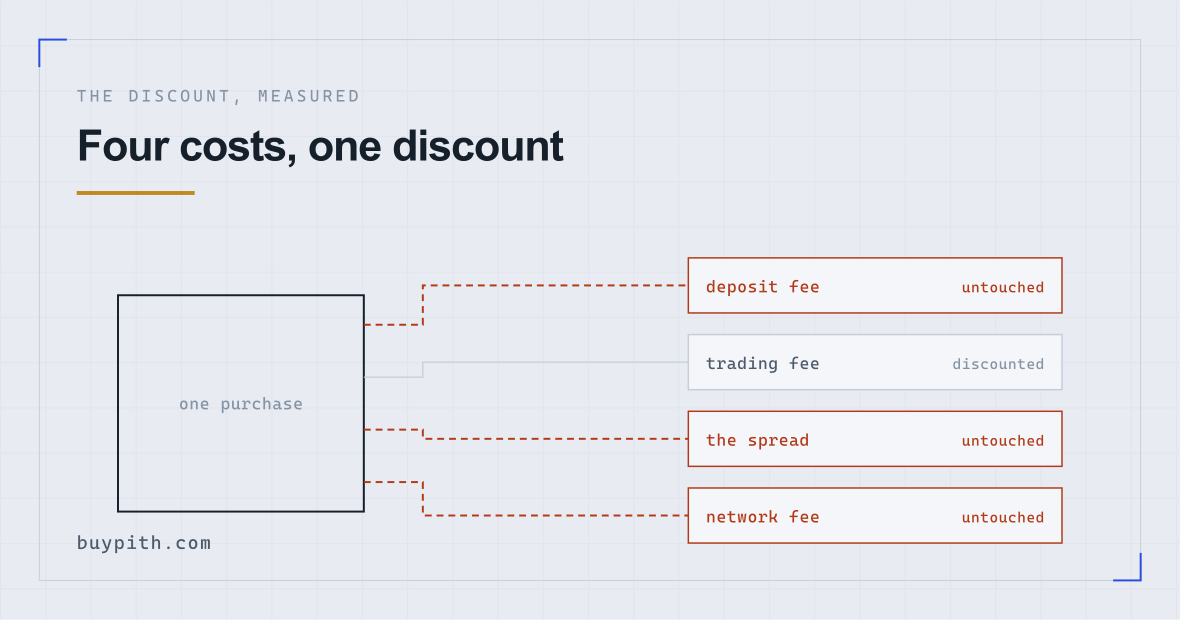
- At most it reduces one thing: the exchange's trading fee. Binance's own programme rules set no standing discount on a new user's fee rate, so treat the sign-up screen as the only figure.
- It does not touch: the deposit fee, the spread, or the network fee — often the larger costs.
- It does not add to what you pay. Missed the code? Some new accounts can bind it within 30 days; the eligibility checks are explained below.
- At beginner volumes it is worth a small amount of money. Worth taking, not worth choosing a platform over.
This is the page where a site that runs on referral income explains its own offer. So the useful thing to do is put the unflattering numbers first: at the volumes a first-time buyer trades, the discount is worth a small amount of money, and three of the four costs of a purchase are completely untouched by it.
It is still worth taking. It just is not the thing that decides anything.
What the code mechanically does
A referral code is normally entered in the sign-up form. A limited late-binding route is covered below. Once attached, it does two things:
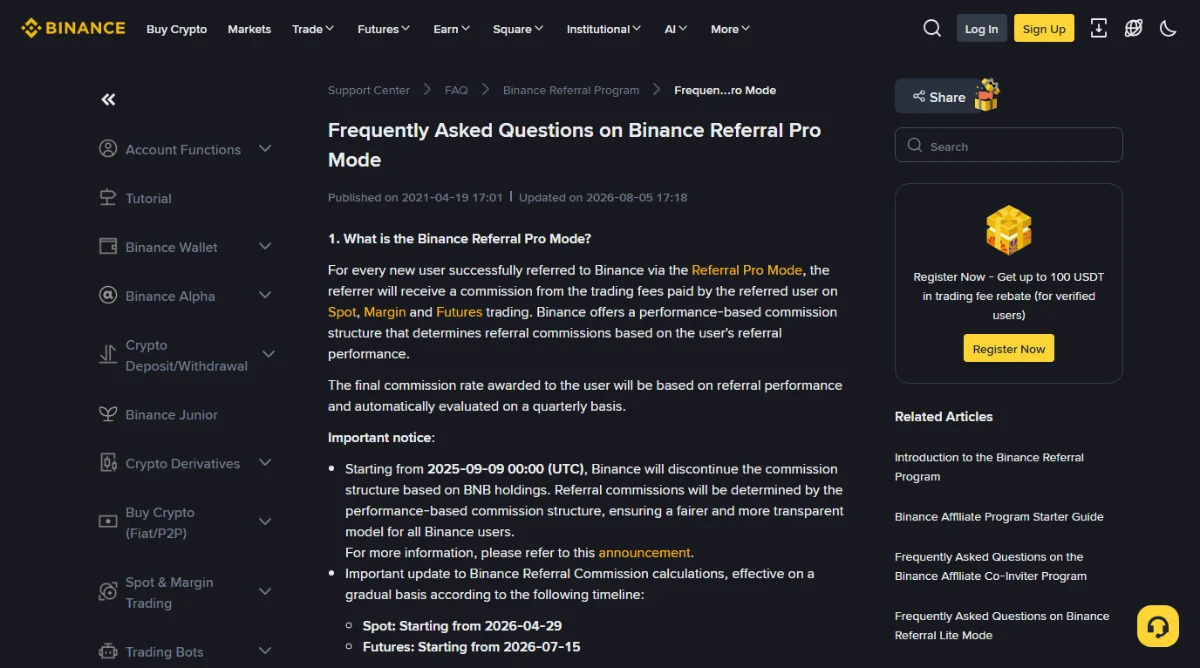
- It may pass part of the exchange's trading fee back to you. Referral pages, including older versions of this one, headline this as “up to 20% off”. That figure does not survive checking: Binance's own introduction to its referral programme (checked October 2026) sets out the commission it pays the referrer — tiered by how much trading that referrer's invitees generate, reviewed quarterly — and sets no standing discount on the referred user's own fee rate at all. Whether any of that commission reaches the person signing up is a setting the referrer chooses when the link is created: Binance's FAQ on Referral Pro mode (checked October 2026) puts it as the referral receiving a rebate “if the referrer chooses to share it with them”. The rate is Binance's to change or withdraw. So the only figure worth trusting is the one its sign-up screen shows you at the moment you register.
- It credits the code owner with a share of the fees you do pay. That is us. It comes out of the exchange's side, not yours.
That is the entire mechanism. It does not link the accounts in any other way, does not let the code owner see your balance or trades, and does not give them any ability to act on your account.
What it does not touch
This is the part that referral pages leave out, and it matters more than the discount does.
A purchase has four separate costs. The code applies to exactly one:
| Cost | Discount applies? | Typical size for a beginner |
|---|---|---|
| Deposit fee (card markup) | No | Often the largest single cost |
| Exchange trading fee | Yes | Usually the smallest of the four |
| The spread | No | Large if you use the simplified widget |
| Network fee (if you withdraw) | No | Fixed, so brutal on small amounts |
So the honest summary is: the code discounts the cost that was already smallest, and leaves the two that are usually biggest completely alone. Anyone presenting a referral code as a way to “save on fees” without saying that is selling you something.
Roughly what it is worth
Real numbers depend on the fee tier in force and on whether a discount reaches you at all, so what follows is arithmetic on a made-up model rather than quoted rates — it assumes a 0.1% trading fee and a 20% discount, i.e. an effective 0.08%. It is an illustration of scale, not a promise that those are your numbers. Read your own rate off the published fee schedule and redo it if you want precision.
| Total you trade | Fee at 0.1% | Fee at 0.08% | You keep |
|---|---|---|---|
| $200 (one first purchase) | $0.20 | $0.16 | $0.04 |
| $1,000 | $1.00 | $0.80 | $0.20 |
| $5,000 | $5.00 | $4.00 | $1.00 |
| $25,000 | $25.00 | $20.00 | $5.00 |
| $100,000 | $100.00 | $80.00 | $20.00 |
On a single first purchase the discount is worth a few cents. That is the truthful answer, and it is why nobody publishes this table.
It becomes real money only with volume — and volume is exactly what a first-time buyer should not be manufacturing. Which leads to the one thing worth saying loudly:
A 20% discount on a fee is still a fee. Every extra trade costs you 0.08% to save 0.02%. If a promotion ever asks you to hit a volume target to unlock something, the volume costs more than the something. This applies to every referral scheme, ours included.
When it is worth precisely nothing
Two situations, and both are common for a first purchase:
You buy through peer-to-peer. Taking an existing advert on the full peer-to-peer order book generally carries no exchange trading fee for the buyer — you pay through the rate in the advertisement instead. The simplified “quick buy” front end to that same market is the exception and does charge, and posting your own advert makes you the maker, who also pays. In none of those cases is there an ordinary trading fee for a discount to reduce, so the code sits on your account doing nothing until you trade on the exchange itself. The fee impact table carries the current published figures, with the date they were read.
You buy once and never trade again. If you make a single purchase and hold, your lifetime saving is the few cents in the top row of that table. Nothing wrong with that outcome — it is just not a reason to have chosen anything.
How to check it actually applied
Check it before submitting the sign-up form. If you have already registered without a code, see the exception below. A lower fee rate afterwards is not the thing to look for.
- Before you submit the sign-up form, expand the referral field and check the code is actually in it.
- Read what the sign-up screen says about the referral at that moment. That screen is the only statement of what, if anything, you get from it.
- Do not judge it by your maker and taker rates later. Binance's programme rules set no standing discount on the referred user's own fee rate, so rates that match the published schedule do not mean the code failed.
- If the referrer has chosen to share part of their commission, Binance's FAQ describes that as a rebate to you — something credited back, not a lower rate on the schedule.
Missed it at sign-up? The Referral Pro FAQ (checked October 2026) allows late binding for a main account within 30 days of registration, with no deposits, trading or existing referral relationship. Your KYC identity must not have been used on another account in the previous 180 days, and the account must not be flagged for wash trading. Open question 4 in that FAQ and follow its binding link if eligible. An established referral cannot be replaced or removed. Do not open or close an account just to change it, and never pay a third party to arrange this.
Our code, and why we are showing you the small numbers
This site is paid for by the code below. We could have written this page the way most referral pages are written — “save up to 20% on every trade!” — and it would have converted better.
The reason not to is straightforward. If you enter the code expecting meaningful savings and later work out it was worth four cents, the useful thing you learn is that this site overstates things. The table above costs us conversions and buys the only thing that matters over more than a month.
Entering it does not increase what you pay. Any discount on your own trading fees is Binance's to set, and lasts only as long as it keeps the arrangement in place*.
* We deliberately do not quote a figure here. Binance's own introduction to its referral programme (checked October 2026) describes the commission it pays the referrer and no standing discount on the referred user's own fee rate. Whatever its sign-up page shows at the moment you register is what applies.
The link below is a promotional link, going to Binance's own sign-up page with our code already filled in. The full arrangement behind it is on our how we make money page. If you would rather use the site without it, go to Binance directly and leave the referral field blank — everything here works the same either way.
If you are not at the sign-up stage yet, the more useful page is the full walkthrough, which covers all seven steps in order and where this one fits.
Questions people actually ask
Does using a referral code cost me anything?
No. The code owner is paid a share of what you pay out of the exchange's side of the fee, and where the referrer chooses to share part of that with you, it comes back to you as a rebate on the trading fee. Your costs go down or stay the same; they cannot go up because of the code.
Can I add a code to an account I already have?
Sometimes. A main account within 30 days, with no deposits, trades or referral relationship, may qualify, subject to KYC and risk checks. See the full conditions above and the official Referral Pro FAQ. An existing referral cannot be changed; do not open another account to get a code.
If a 20% discount does apply, is that a lot?
Not at beginner volumes. On a single small purchase it would be worth a few cents, because it only touches the trading fee — usually the smallest of the four costs — and leaves the deposit fee, spread and network fee untouched. It becomes real money only at trading volumes a first-time buyer has no reason to reach. And 20% is the headline figure referral pages use, not something Binance promises the person signing up.
Does the discount apply to peer-to-peer trades?
Generally not. Taking an existing advert on the full peer-to-peer book usually carries no exchange trading fee to begin with, so there is nothing for a discount to reduce — the cost sits in the advertised rate instead. The simplified quick-buy version of that market does charge its own fee, but that is not the trading fee the discount applies to either. The discount starts mattering once you trade on the exchange itself.
How do I know whether it worked?
Check at sign-up: expand the referral field before submitting and read what the sign-up screen says about it. Do not judge it by your fee rate afterwards — Binance's programme rules set no standing discount on the referred user's own rate, so rates matching the published schedule do not mean it failed. Any share the referrer passes back arrives as a rebate, not a lower rate.