The question that stops people before they start
Can I buy less than one bitcoin?
Yes — down to eight decimal places. The belief that a whole one is the entry ticket takes one sentence to dissolve; what actually sets the floor on a first purchase is something else entirely.
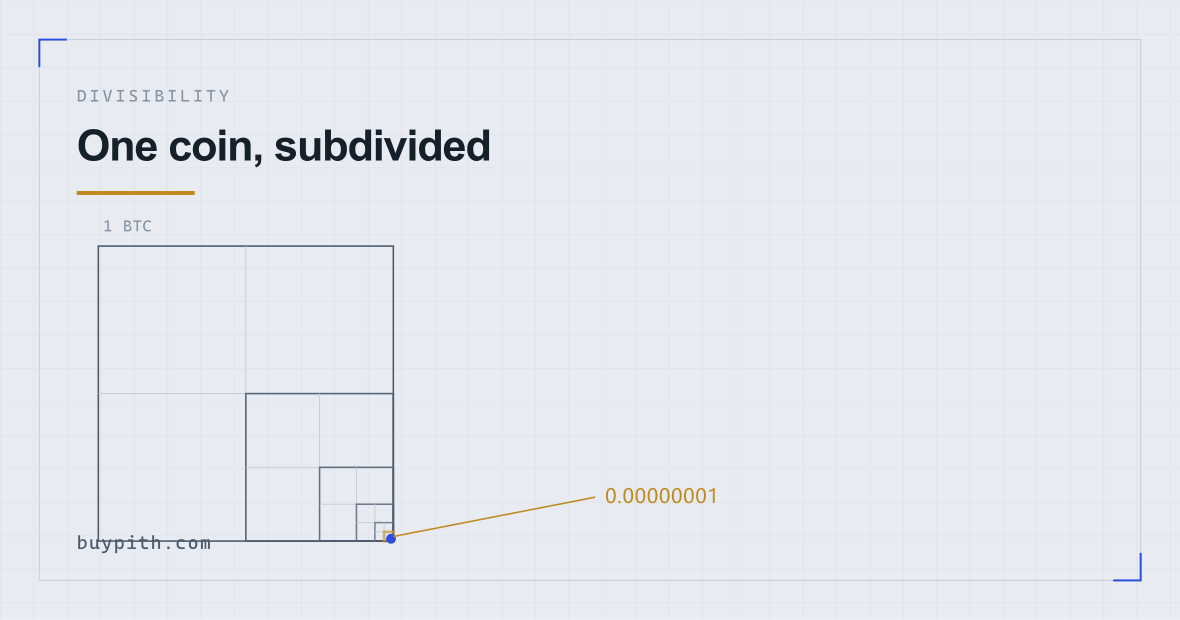
Yes. A bitcoin divides into 100,000,000 units, and buying a fraction is the ordinary case rather than a special arrangement. What limits you is a small minimum order value in your own currency — typically a few dollars — not the price of a whole coin.
It is worth pausing on how sensible this misconception is. Everywhere else, the unit is the thing. You buy a share, a ticket, a car. Nobody sells a fifth of a concert ticket. So when a headline says a bitcoin costs some enormous number, the reasonable inference is that the enormous number is the entry fee.
It is not. Divisibility was designed in from the start, and the smallest unit — one hundred-millionth of a bitcoin — is called a satoshi, after the pseudonymous author of the original paper. Eight decimal places, all usable.
What you type into the order screen
Every exchange lets you enter the amount either way, and the two boxes update each other:
- In your currency — type 40, get whatever quantity of bitcoin 40 buys today. This is the sane way round when you have a budget rather than a target quantity.
- In bitcoin — type 0.0005, see the cost in your currency. Useful when you want a specific quantity, rarely what a beginner actually wants.
Your balance afterwards will show something like 0.00042851 BTC, and looking at a number with that many zeros in it feels odd for about a week. It is arithmetic, not a consolation prize: a fraction of a bitcoin moves in value by exactly the same percentage as a whole one.
So what actually sets the floor?
Three things, none of which is the coin price:
- The minimum order value on the trading pair. Exchanges impose a small minimum in the quote currency — commonly a low single-digit amount — because settling an order worth a fraction of a cent costs them more to process than it is worth. It is shown on the order screen and it moves; the detail is here.
- The minimum deposit on your funding route. Card and bank transfer each have their own floor, and it can be higher than the trading minimum.
- Fees, in practice rather than in rules. Nothing stops you buying the minimum. But a fixed cost taken out of a very small purchase is a large slice of it, which is the arithmetic that actually matters and the reason “you can start with $5” is technically true and quietly misleading.
Where the confusion is reinforced
Two habits keep the whole-coin idea alive. Price coverage always quotes one bitcoin, because that is the convention, so the enormous number is the only one anybody ever sees. And people who already own some talk in whole units out of habit, which makes fractions sound like the beginner's version of the real thing.
There is no beginner's version. A satoshi is the same asset as a bitcoin in the same way a cent is the same currency as a dollar.
Some people, on discovering fractions are fine, then buy a very small amount of a very cheap coin instead — on the reasoning that thousands of units feels more substantial than 0.0004 of something. The unit count tells you nothing about anything. A coin priced in fractions of a cent has priced itself that way by issuing an enormous number of units, and owning ten thousand of them is not further along than owning a fraction of one bitcoin.
Reading a balance with eight decimal places
The first time your balance shows something like 0.00061204 BTC, it reads as a rounding error rather than a holding. Two things make it easier to live with.
First, most interfaces show the value in your own currency next to the quantity, usually as the larger and more prominent of the two numbers. That is the one that tells you anything useful day to day. The eight-decimal figure is the quantity you own; it does not change unless you buy or sell.
Second, some wallets and a lot of enthusiasts display holdings in satoshis instead, so the same amount reads as 61,204 sats. It is the identical quantity expressed in a smaller unit — the same trick as quoting a price in cents rather than dollars. Neither presentation is more real than the other, and switching between them does not change what you have.
What genuinely trips people up is comparing the quantity figure across different assets. Owning 0.0006 of one thing and 4,000 of another says nothing about which holding is worth more. Unit counts are an artefact of how many units were issued, and comparing them is like judging two salaries by the number of banknotes.
The one place fractions actually matter
There is a real limitation, and it is not the purchase.
Moving coins off an exchange to a wallet you control means paying a network fee, which is charged in absolute terms rather than as a percentage. If your holding is very small, that fee can be a substantial share of it — and exchanges set a minimum withdrawal amount precisely so a withdrawal cannot cost more than it moves. The withdrawal floor is often several times the purchase floor.
So the accurate version is: you can buy almost any fraction, and you can hold and sell it without difficulty. What you cannot necessarily do at every size is take it off the platform. If self-custody is part of your plan, that threshold is worth checking before the purchase rather than after.
Once the whole-coin idea is out of the way, the remaining questions are practical ones: what it costs, how the order screen works, and where the coins sit afterwards. The full walkthrough takes those in order.
Questions people actually ask
What is a satoshi?
The smallest unit of bitcoin: one hundred-millionth of one, or 0.00000001 BTC. It is named after Satoshi Nakamoto, the pseudonym attached to the original bitcoin paper. Exchange interfaces usually display balances in BTC with eight decimal places rather than in satoshis, but some wallets show both.
Is buying a fraction different from buying a whole bitcoin?
Only in size. The same asset, the same percentage moves, the same fee structure, the same everything. There is no separate product, no different terms, and no lower class of ownership.
Can I buy exactly $50 worth?
Yes. Enter 50 in the currency field and the exchange calculates the quantity, usually deducting the fee so you can see what you actually receive. The quantity will be an untidy number with several decimal places, which is normal.