Step 06 · before you press the button
What goes wrong on a first purchase — and why people walk into it
Every item here is something a sensible person does for a sensible reason. Mostly the reason is that an interface offered it as the default, or a sentence meant something other than what it appeared to mean. Very little of it is carelessness.
Buying a larger amount than planned because the price went up while you were reading. It feels like new information arriving. It is not: it is the same asset, more expensive, and the urge to act arrived precisely when acting is least considered. Everything else on this page costs a few percent. This one is what turns a small experiment into a large regret.
Lists like this are usually written as though the reader is careless. They are not. Almost everything below happens because a screen offered something as the obvious path, or a phrase carried a meaning it does not carry in ordinary English. Knowing the mechanism is more useful than being told not to do it.
Using the convenient buy button without noticing it is a different product
Why people do it: it is the large, friendly button. The alternative is a screen with a chart, an order book, and words like “maker” on it, which looks like something you need a licence to touch.
On most platforms the simplified buy widget and the actual trading interface are separate products with separate pricing. The convenient one bundles its cost into the price you are quoted rather than showing it as a fee, and the number it bundles in is usually larger. You are paying for the absence of the chart.
That can be a fine trade for a first purchase. It stops being a fine trade on the fifth one, when the difference has quietly compounded. Opening the trading screen once, with a small amount, is how you find out what the gap is for you — and it is less intimidating than it looks.
Paying by card because it is the top option
Why people do it: it is first in the list, it works immediately, and everything else asks for patience.
Card funding is the most expensive ordinary route on nearly every platform, and on a small purchase the markup is a meaningful share of what you put in. The arithmetic on that is unflattering. A bank transfer usually costs nothing to deposit; depending on the country and the rail it lands anywhere from minutes on an instant scheme to a few working days.
The honest version of this trade is: are those days worth several percent of your money? Sometimes yes. But it should be a decision rather than a consequence of the ordering of a list. The full comparison covers the other differences too, including which one gets declined more often.
Reading “up to 20% off” as a return
Why people do it: percentages in financial contexts usually describe gains, and the eye reads them that way.
A fee discount reduces what you pay to trade. It is not income, not a bonus, and not a yield. Up to twenty percent back on a small fee is a small amount of money — and on Binance it is a share of the referrer's commission that they may pass back, not a discount on your own rate: worth having if offered, not worth choosing a platform over, and definitely not worth trading more to “use”.
The version of this that costs real money is a genuine promotional bonus with a volume condition attached: trade a certain amount within a window to unlock it. That converts a small reward into a reason to make trades you would not otherwise make, each of which carries its own fee. Read what the condition asks before treating anything as free.
Skipping the security setup because the account is empty
Why people do it: it is genuinely rational at that moment. There is nothing to steal, and the setup screens are tedious.
The problem is that the moment it stops being rational — when money arrives — is also the moment nobody goes back to settings. The gap between funding and hardening is where accounts get taken, and it is a gap people create by being sensible at the wrong time.
Four settings, ten minutes: authenticator-app two-factor rather than SMS, backup codes written on paper, an anti-phishing phrase, and withdrawal address whitelisting. The account guide covers each one. The anti-phishing code in particular is close to free and defeats most of the phishing aimed at new holders.
Treating a community as a source of information
Why people do it: a group of people who all sound certain is indistinguishable, from the outside, from a group of people who all know something.
What a crowded chat actually transmits is confidence, and confidence is generated by whoever is most invested and least reflective. Nobody posts about the position they are down on. The selection effect is severe enough that the aggregate mood of a group is closer to a contrary indicator than a signal.
Anyone offering to trade on your behalf, guarantee a return, help you “recover” a loss, or walk you through a platform they recommend by direct message is running a scam. There are no exceptions to this, the approach is always friendly, and new accounts are targeted specifically because they are new. No legitimate person needs your password, your 2FA code, or remote access to your screen.
Buying several things at once
Why people do it: spreading out feels like prudence, and the interface lists dozens of assets with the same visual weight, which implies they are the same kind of thing.
They are not. On a first purchase, five assets means five sets of fees, five things to record for tax, and five sets of research you have not done — while the actual educational content of the exercise is identical to buying one. Diversification across assets that all move together is not diversification; it is more paperwork.
The list being long is a product decision by the exchange, not a statement about how many of them are worth owning.
Not writing down what you did
Why people do it: it feels like a bookkeeping problem for someone who trades, not for someone who bought once.
In many countries the first purchase is already a taxable event with a record-keeping obligation attached, and the obligation begins immediately rather than when you sell. Exchange statements are exportable but incomplete, especially across a platform change or an account closure, and reconstructing a year-old transaction from them is genuinely miserable.
Date, amount in your currency, quantity received, fee paid, platform. Five fields in a spreadsheet, thirty seconds, once. This is the single highest-value item on this page relative to the effort it takes.
Two things that get called mistakes and are not
Lists like this tend to accumulate items through repetition rather than reasoning, and two in particular get repeated at beginners without much thought behind them.
“Buying a tiny amount is pointless”
Usually said by people who forgot that the purpose of a first purchase is to find out how the process works and how you react to it, not to build a position. A small purchase does both of those at a small cost.
The legitimate criticism hiding inside it is about fees: at the very bottom of the range, a fixed cost is a large share of what you put in, so a very small purchase is an expensive way to learn in percentage terms. That is an argument about the size of the fee, not about whether learning cheaply is worthwhile. Paying two or three percent once to understand a process is not a mistake; paying it every week for a year is.
“Leaving coins on the exchange is reckless”
Stated as an absolute rule it is wrong, and the absolutism does real harm: people who hear it either panic-move a small holding into a self-custody wallet they do not understand, or ignore the advice entirely because it sounds like zealotry.
The accurate version is proportional. An exchange balance is a claim against a company rather than an asset in your hands, and that trade-off is reasonable for a small amount and increasingly unreasonable as the amount grows. A rushed first self-custody attempt, with the recovery phrase screenshotted into a photo library that syncs to a cloud account, is meaningfully worse than leaving a modest amount on a well-secured exchange account. Learn it calmly, at a time of your choosing, with a small test transfer first.
The pattern underneath all of these
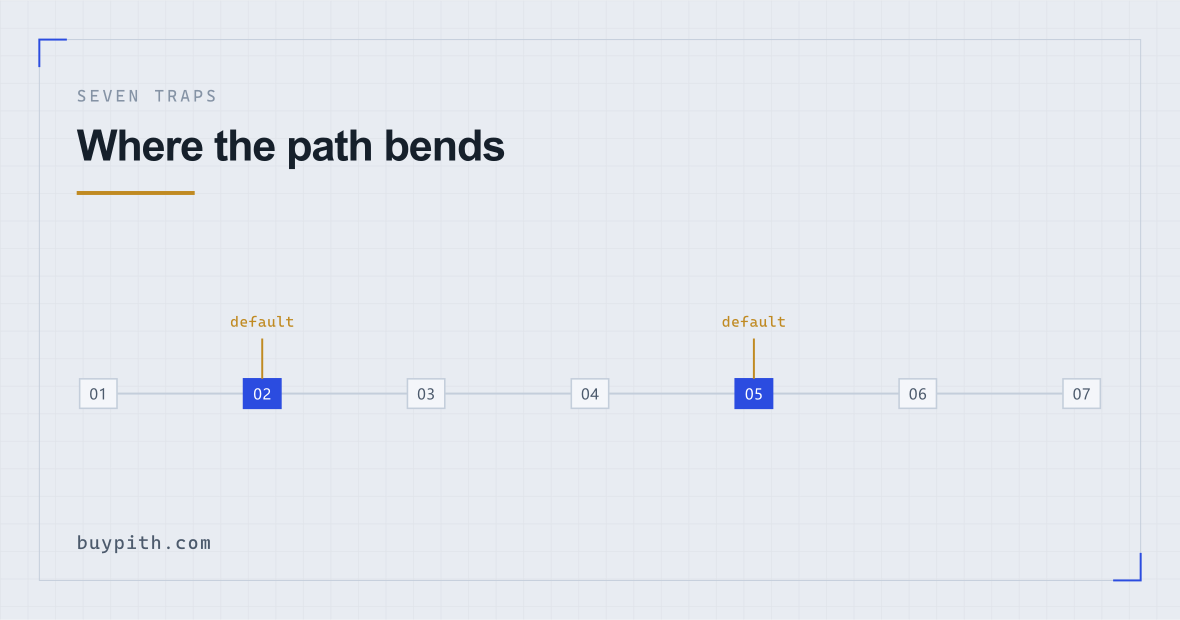
Six of the seven come from accepting a default. The interface is not malicious about it — defaults exist because most users want the fast path — but the fast path is priced, and the pricing is not shown in the place where the choice is made.
Which suggests a single habit that is worth more than memorising the list: on each screen, find the option that is not pre-selected and work out why it exists. The other funding method, the other order type, the settings page nobody visits. Usually there is a reason, and usually the reason is money.
What the pattern looks like in published numbers
This is normally the point where an article like this asks you to take its word for it. It does not have to. The pricing is published, and on 2026-08-26 it read like this on one large exchange.
The convenient card button charges 2%. The trading screen — identical asset, identical platform, a few more clicks — charges 0.100% for an ordinary account (the live figures are on Binance's fee schedule). That is a factor of twenty, and the only thing separating the two numbers is which screen you arrived through.
The same shape repeats one level down, which is the part that makes it convincing rather than anecdotal. That exchange's full peer-to-peer order book charges the buyer nothing for taking an existing advert. Its simplified quick-buy version of that same market, with fewer decisions to make, charges 0.2%. Nobody is being defrauded in either case and both prices are published. But in both cases the cheaper option is the one with the extra step, and neither screen mentions that the other exists.
There is a third instance, quieter than the other two, and it is the one that reaches everybody rather than only card users. The order form opens on market by default. A market order fills immediately, which by definition makes you the taker of somebody else's resting offer, and on that exchange's published schedule the taker is charged more than the maker on fiat pairs — 0.1500% against 0.1000%, half as much again. On crypto-to-crypto pairs the two rates were identical, so the penalty only appears when you are buying with ordinary money, which is exactly what a first purchase is.
The honest size of this one: on a small purchase the difference is pennies, far less than the card gap above, and it is not a reason to fight with an order form you do not understand. It matters because of what it reveals rather than what it costs. A limit order also only earns the maker rate if it actually rests — one that fills the instant you place it is a taker order wearing a different name. Which of the two suits a first purchase is a separate question, and the fee is the smallest part of the answer.
Two cautions about those figures: they were read on 2026-08-26 and will drift, and they vary by country, payment provider and account tier. The fee impact table carries the full snapshot with its date and a link to the source, and the source is where to check before acting on any of it. What outlasts the drift is the relationship rather than the digits — the pre-selected path costs more, consistently, at every layer.
If you have already done several of these
Most people reading this have. Here is what is still recoverable and what is not, because the distinction saves a lot of pointless worrying.
Recoverable, today: the security settings, which take ten minutes and are exactly as effective whether you do them before or after the money arrives. The transaction record, which you can reconstruct from your order history right now while it is still there. The choice of funding route, which only applies to purchases you have not yet made.
Not recoverable: the fee you already paid on the first purchase. It is spent, and the amount is almost certainly smaller than the time you would spend being annoyed about it. Treat it as the tuition and move the attention to the next one.
Recoverable but only by not repeating it: the habit items. Checking the balance constantly, adding money on a price move, treating a group chat as research. None of those are undone by a decision; they are undone by a week of not doing them, and the first week is when they set.
If you have already bought and recognise a few of these, none of it is fixable by worrying. The post-purchase checklist covers what is still worth doing today — the security settings and the record are both still available to you, and both still matter.