Step 07 · after the order fills
Where do my coins actually go after I buy?
“I bought it and now I cannot find it” is one of the most common panicked searches there is. The coins are almost certainly fine. What is missing is an explanation of what an exchange balance actually is.
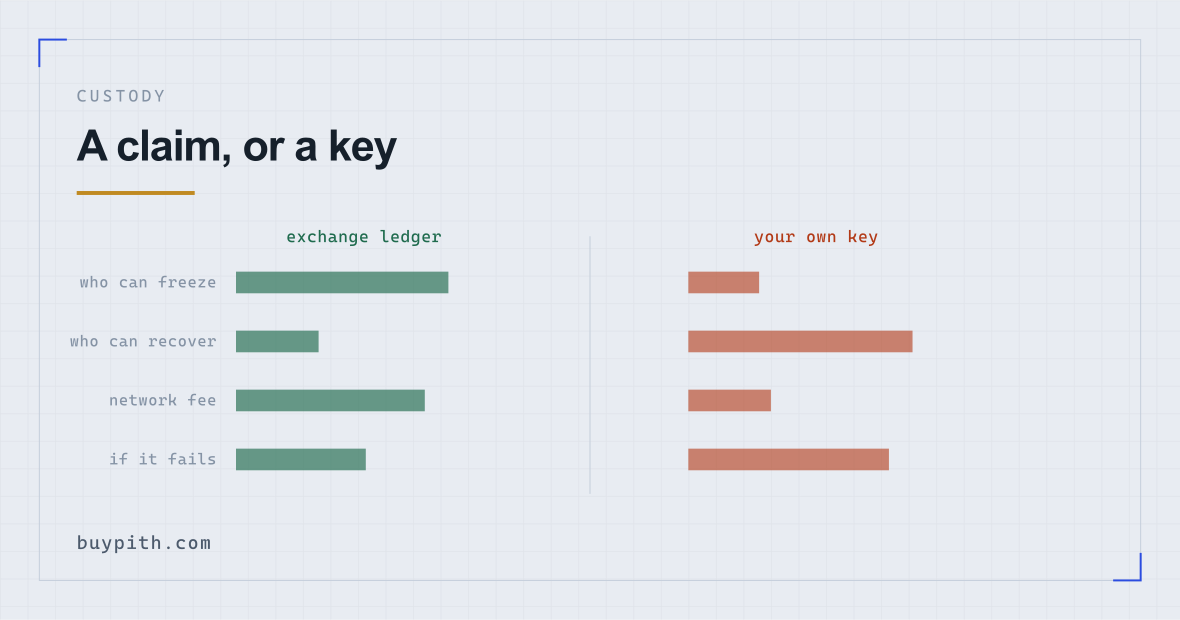
In the exchange's records, under your account. Buying on an exchange does not move anything on a blockchain — it updates a database saying the exchange owes you that quantity. That is a genuine holding and a normal way to start; it is simply not the same thing as holding the asset yourself, and the difference matters more than it sounds.
The confusion here is entirely reasonable, and it comes from the word “coin”. Coins are objects. Objects are somewhere. So after buying one, the natural question is where the object went, and the natural fear is that it did not arrive.
It arrived. But the thing that arrived is not an object, and understanding what it actually is resolves several other questions at once.
What your balance is
When you buy on an exchange, nothing is broadcast to a blockchain. The exchange has its own internal ledger, and your purchase changes two rows in it: your currency balance goes down, your bitcoin balance goes up. The seller's rows change the other way. No network transaction occurs, which is why the trade is instant and why no network fee was charged.
So the accurate description of your holding is: the exchange owes you that quantity of bitcoin. It is a claim against a company, recorded in that company's system.
This is called custodial holding, and it is not a trick or a lesser product — it is how brokerages hold most assets for most people in most markets. But two consequences follow that do not apply to a bank account.
No deposit guarantee. The schemes that protect bank deposits in your country almost certainly do not cover a crypto balance. If the exchange fails, you are a creditor, and creditors of failed crypto platforms have historically recovered a fraction of what they held, years later.
Access depends on the platform. Withdrawals can be suspended for maintenance, during incidents, or while an account is under review. Your balance is visible and correct, and still not movable that day. This is ordinary and temporary in almost every case — and it is not something you control.
For a small first purchase, most people accept this knowingly and leave the coins where they are. That is a defensible choice. The phrase people quote at each other — not your keys, not your coins — is not a slogan about paranoia; it is a literal description of the arrangement above.
What a wallet actually is
The alternative is self-custody, and the word “wallet” is unhelpful because it suggests a container holding your coins. It does not hold anything.
Ownership on a blockchain is recorded on the network itself: the ledger says a certain quantity is associated with a certain address. What decides who can move it is a private key — a secret number. A wallet is software or hardware that stores that key and uses it to sign transactions.
Which gives self-custody its defining property: nobody can freeze it, and nobody can help you. Lose the key and the coins remain visible on the network forever, permanently unspendable. There is no reset, no support line, no recovery process. That is not a flaw in the design; it is the design.
Most wallets present the key as a recovery phrase — usually twelve or twenty-four ordinary words. Those words are the money. Anyone who reads them can take everything, instantly and irreversibly, which is why every scam eventually asks for them and why nobody legitimate ever will. The basics of storing one safely are worth reading before you generate one rather than after.
What pressing withdraw actually does
Moving coins from an exchange to a wallet you control is the moment a real blockchain transaction happens. The sequence:
- You give the exchange a destination address — a long string generated by your wallet.
- You choose a network. This matters enormously and is covered below.
- The exchange broadcasts a transaction moving the amount to that address, and deducts a network fee: a flat amount per network that covers the on-chain cost, set by the exchange rather than passed through at whatever the chain charged that minute.
- The network confirms it over some minutes. You can watch this on a public explorer like mempool.space by pasting the transaction ID.
- Your wallet shows the balance once enough confirmations have accumulated.
Two things about this are unforgiving, and both are worth stating before you attempt it.
The address must be exactly right. Send to a wrong but valid address and the coins are gone — not delayed, not recoverable, gone. Always copy and paste, never retype, and check the first and last several characters after pasting. Clipboard-hijacking malware exists specifically to swap a copied crypto address for the attacker's, and checking the ends defeats it.
The network must match. The same asset often exists on several networks, and sending over one network to an address that only exists on another commonly loses the funds permanently. When the withdrawal screen asks you to pick a network, that dropdown is the most consequential control on the page.
What “proof of reserves” does and does not tell you
After several high-profile platform failures, exchanges began publishing proof-of-reserves reports, and they get cited as though they settle the custody question. They do not, and it is worth knowing what they actually establish.
A proof-of-reserves exercise generally demonstrates that the platform controls a quantity of assets at a point in time, and increasingly that this quantity covers customer balances as recorded in its own ledger. That is genuinely useful and considerably better than nothing.
What it does not establish: whether those assets are encumbered — borrowed, pledged, or owed to someone else — because a snapshot of holdings says nothing about liabilities that are not customer balances. It also does not establish anything about the days between snapshots, or about the platform's solvency in any broader sense.
So the correct weight to give it is: a reassuring signal, not a guarantee, and not a substitute for the basic point that a balance on a platform is a claim rather than a possession. Read one if you like — most large exchanges publish theirs, and Binance's is here — but read it as one input rather than as the answer.
Why a very small holding cannot leave
The network fee is a flat amount per withdrawal on a given network rather than a percentage of the amount. Moving a small holding therefore costs the same as moving a large one, which can consume a startling share of a small balance.
Exchanges deal with this by imposing a minimum withdrawal amount, frequently several times the minimum purchase. So it is entirely possible to buy an amount you cannot withdraw — the coins are yours, sellable, visible, and not movable off-platform until the balance clears the floor. The four different minimums covers where each one is set.
What to actually do about it
No universal answer, but the shape of the decision is clear enough:
- Small amount, just started. Leaving it on a reputable exchange is normal. Secure the account properly — that is where your risk actually is, and the checklist takes ten minutes.
- Amount growing into something you would mind losing. This is the point to learn self-custody, calmly, before the amount gets larger. Practise with a small transfer first; a wasted network fee is a cheap rehearsal.
- Amount you would be genuinely upset to lose. Self-custody with a hardware wallet, and a recovery phrase stored offline in a place that survives fire and flood. And a plan for what happens to it if you do not.
The mistake in both directions is the same: doing it without understanding it. Leaving a large amount on an exchange because moving it seemed complicated is one failure. Rushing coins into a self-custody wallet whose recovery phrase is a screenshot in your photo library is the other, and it is the more common one.
Questions people actually ask
I bought bitcoin but I cannot see it. Where is it?
Check the spot or funding wallet section of your exchange account rather than the buy screen — most platforms separate balances into several areas and a purchase lands in one of them. If the order shows as filled in your order history, the coins exist; they are in a part of the interface you have not opened yet.
Is my bitcoin safer on the exchange or in a wallet?
Different risks, not more and less. On an exchange, the risk is the company: failure, freezes, and account compromise. In self-custody, the risk is entirely you: losing the key means losing the coins with no recovery. For a small amount, a well-secured exchange account is a reasonable choice; for larger amounts the calculation shifts.
Does buying on an exchange put a transaction on the blockchain?
No. The trade happens inside the exchange's own ledger, which is why it is instant and free of network fees. The blockchain is only involved when coins move in or out of the platform.
What happens if I send to the wrong address?
In almost every case the funds are permanently lost. There is no central authority to reverse a confirmed transaction and no support process that can recall it. Copy and paste the address, then verify the first and last several characters before confirming.