Step 01 · the money question
How much do you actually need to start?
Two different questions get asked in the same sentence. What is the minimum I can buy has a small, boring answer. What amount makes sense is arithmetic about fees, and the answer is bigger than the minimum by a long way.
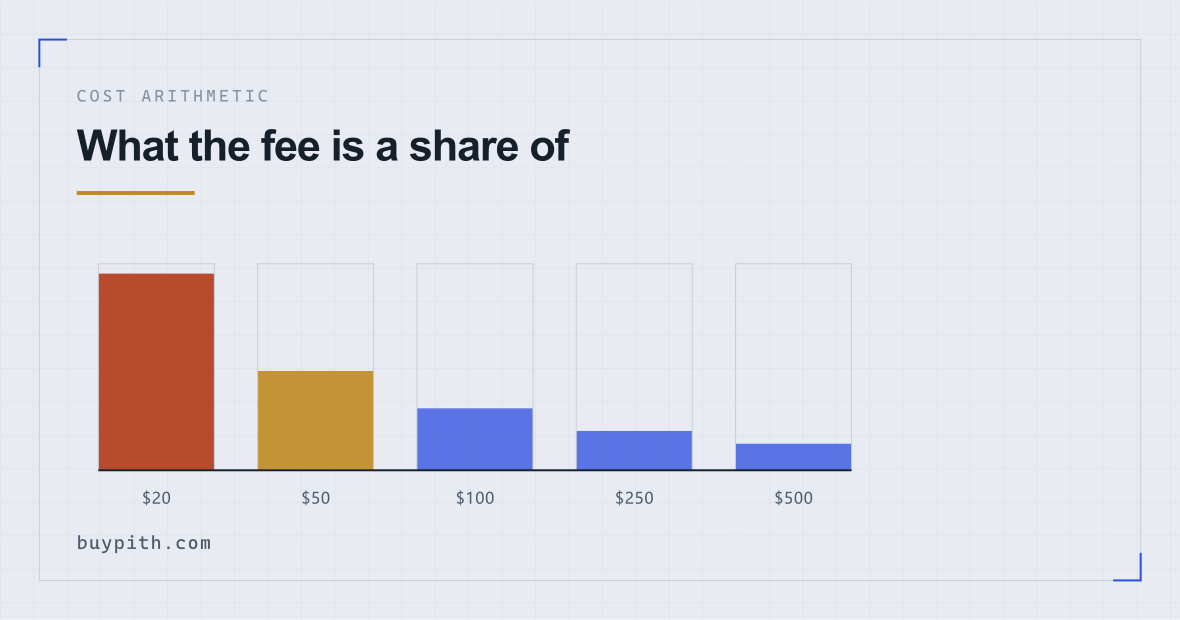
You can start with a few dollars — exchange minimums are genuinely that low. But a fixed cost taken out of a tiny purchase is a large percentage of it, so very small first buys hand over a share of your money that would look alarming written as a number. The cheap-to-buy threshold is set by which funding route you use, not by the exchange's minimum.
Search this question and you get two kinds of answer. One says “you can start with $10!” and stops there, which is true and useless. The other says “never invest more than you can afford to lose”, which is true and equally useless because it is not a number.
Neither addresses what people are actually asking, which is: at what point does this stop being silly? That has an answer, and it comes from arithmetic rather than opinion.
The minimum is real, and it is tiny
A bitcoin is divisible to eight decimal places. The smallest unit — a satoshi — is one hundred-millionth of one. Nothing about the asset requires you to buy a whole one, and the belief that it does is the single most common misconception among people who have not started.
What sets the floor in practice is the exchange's minimum order value on a trading pair, which is typically a low single-digit amount in your currency, and the minimum deposit on whichever funding route you use. Both are small. The exact figures move and differ by pair and by country, so the order screen is where you check rather than an article.
So: technically, a cup of coffee. Now the part the technically-true answer skips.
Why small purchases lose a big share to costs
Some of what you pay is a percentage, and some is effectively fixed. The percentage parts do not care how much you buy — they take the same slice from a $20 purchase and a $2,000 one. The fixed parts are where small purchases get hurt.
Fixed or near-fixed costs include the minimum charge some card processors apply, and any flat deposit fee your funding route carries. A flat charge of a couple of dollars is nothing on a large purchase and is a tenth of a $20 one.
Here is the shape of it, using a deliberately simple model: a 1% percentage cost and a $2 fixed cost. These are illustrative round numbers chosen to show the arithmetic, not quoted rates from any platform — real rates depend on your country, your payment method, and the fee schedule in force, and you should read them off the exchange's own fee schedule rather than from us.
| You put in | 1% of it | Plus $2 fixed | Total cost | Share of your money |
|---|---|---|---|---|
| $20 | $0.20 | $2.00 | $2.20 | 11.0% |
| $50 | $0.50 | $2.00 | $2.50 | 5.0% |
| $100 | $1.00 | $2.00 | $3.00 | 3.0% |
| $250 | $2.50 | $2.00 | $4.50 | 1.8% |
| $500 | $5.00 | $2.00 | $7.00 | 1.4% |
The percentage column is the whole story. At $20 you are handing over more than a tenth of your money before the price has moved at all — the asset has to gain 12% just to get you back to level. At $250 the same fee structure costs under 2%. Nothing changed except the size of the denominator.
Do not treat the numbers above as rates. Take the actual figures from the fee screen at the moment you buy, and run the same arithmetic. The fee impact table does it across a range of amounts and cost structures so you can find the row that matches your situation.
The funding route matters more than the amount
The fixed component above is usually not the exchange's trading fee. It comes from how you got the money in. That is why the first practical move for anyone worried about cost is not “buy more” — it is “fund differently”.
- Card payments are quick and carry the highest markup on nearly every platform. On a small purchase that markup dominates everything else.
- Bank transfers are slower and frequently free to deposit, which removes most of the fixed component entirely.
- Credit cards can add a separate cash-advance fee and interest from your card issuer, on top of everything the exchange charges. This is usually the most expensive route available.
The comparison between the two ordinary routes covers speed, limits, and reversibility as well as cost. For a first purchase, the honest summary is that a few days of patience is worth more than most people assume.
So what is a sensible first amount?
Two boundaries, and the space between them is yours to choose.
The lower boundary is arithmetic. Pick an amount where total costs land somewhere you would not wince at written as a percentage. Run the numbers from your own fee screen; work out which amount takes you under a threshold you can live with. That is a calculation, not a judgement.
The upper boundary is not our business, and here is why. Nobody writing an article knows your income, your debts, whether you have savings, or how you react when a number drops. Any site that names a figure is guessing, and a site that earns money from sign-ups guessing high is doing something worse than guessing. So: no number from us.
What we will offer is a test rather than a figure. Would you still be comfortable if this amount fell by half tomorrow and stayed there for two years? Not “would you be annoyed” — that is fine and expected. Would anything in your life have to change? If the answer is yes, the amount is too big, regardless of what it is. That has happened to bitcoin repeatedly and there is no reason to assume it will not again.
Borrowed money, rent, an emergency fund, or anything with a deadline attached to it. A forced seller has no strategy, only a schedule. This is also why the credit-card route is worse than it looks: it is borrowing to buy a volatile asset, with interest running from day one.
Three ways people arrive at a number, and what each is really doing
Watch how the decision actually gets made and it is almost never arithmetic. It is one of these three, and it is worth recognising which one you are using.
“A round number that sounds serious”
A hundred, five hundred, a thousand. The figure is chosen because it sounds like a real commitment rather than a token, which is a statement about how you want to feel rather than about what you can absorb. Round numbers are also, by construction, the ones most likely to be picked without checking anything.
The fix is not to avoid round numbers. It is to run the round number through the loss test below and see whether it survives.
“What the person who told me about it put in”
Anchoring to someone else's figure imports their income, their obligations, and their risk tolerance along with the number, none of which you can see. It also imports their timing, which is the part they are least likely to have mentioned if it went badly.
The version of this that does real damage is matching a figure to avoid looking cautious in front of people whose finances you know nothing about.
“Whatever is spare in the account right now”
The most defensible of the three, and still worth examining. Money that is currently unallocated is not the same as money with no future claim on it — a quarterly bill, an annual renewal, or a car that is going to need something all have a way of appearing after the money has been converted into an asset you would rather not sell.
The improvement here is small: look at what leaves your account over the next three months before deciding what is spare over the next three years.
Work out the total cost percentage at a few candidate amounts from your own fee screen. Pick the smallest amount where that percentage is one you would accept. Then apply the loss test to it. If it survives both, that is your number, and it was produced by two checks rather than by a feeling.
The case for making the first one small anyway
There is a reason to buy a small amount that has nothing to do with cost efficiency, and it is probably the strongest argument on this page.
A first purchase is an experiment about you, not about the asset. What you learn is how it feels to watch a number move when your own money is attached to it. Some people glance at it once a month. Others check it eleven times before lunch and discover something uncomfortable about themselves. You cannot find out which one you are by reading; you find out by having a position, and the size that teaches you this is small.
Paying a slightly unflattering percentage in fees for that information is a reasonable trade, as long as you go in knowing that is what you are buying. What is not reasonable is repeating tiny purchases weekly at a bad fee ratio for a year, which is how a one-off learning cost becomes a permanent tax on the exercise. If the plan is to buy regularly, larger and less often costs meaningfully less than smaller and more often — and that is arithmetic, not advice.
Once the purchase is done, there are three things worth doing straight away, one of which is writing down what you paid. That list is short and the tax-record part of it is the one people regret skipping.
Questions people actually ask
Is there a minimum amount of bitcoin I have to buy?
Not in the way people expect. There is no rule that you buy a whole coin or a fixed fraction. What exists is a small minimum order value on each trading pair, set by the exchange in your currency, plus a minimum deposit on your funding route. Both are typically low single-digit amounts, and both are shown on screen when you order.
Do fees really matter on a small purchase?
They matter most on a small purchase. Percentage-based costs scale with the amount, but flat costs do not — so a fixed charge that is trivial on a large purchase can be a double-digit percentage of a very small one. The size of the purchase does not change the fee; it changes what the fee is a percentage of.
Is it cheaper to buy once or to buy a little every week?
On fees alone, less often and larger is cheaper, because you pay any fixed component fewer times. Whether that outweighs the reasons people buy regularly is a separate question about your own preferences, and not one this site takes a position on.
Why will you not just tell me an amount?
Because we do not know your income, your debts, whether you have savings, or what you would have to give up if the money disappeared — and a site that earns when people open accounts, guessing high, is doing something worse than guessing. What we can give you is the cost arithmetic, which is genuinely calculable, and a test you can apply yourself: an amount that could fall by half and stay there for two years without changing anything in your life.
Does the referral discount change how much I need?
Barely. A fee discount applies to the exchange's trading fee, which for a small first purchase is usually the smallest of the several costs involved. It is worth having and it is not a reason to buy more, or to pick a platform. The funding route you choose moves the total far more than any discount does.