Technically yes. Three costs stack.
Can I buy crypto with a credit card?
The answer is often yes and the interesting part is what it costs. Two separate companies charge you for this — the exchange and your card issuer — and the second one is the expensive half that nobody sees coming.
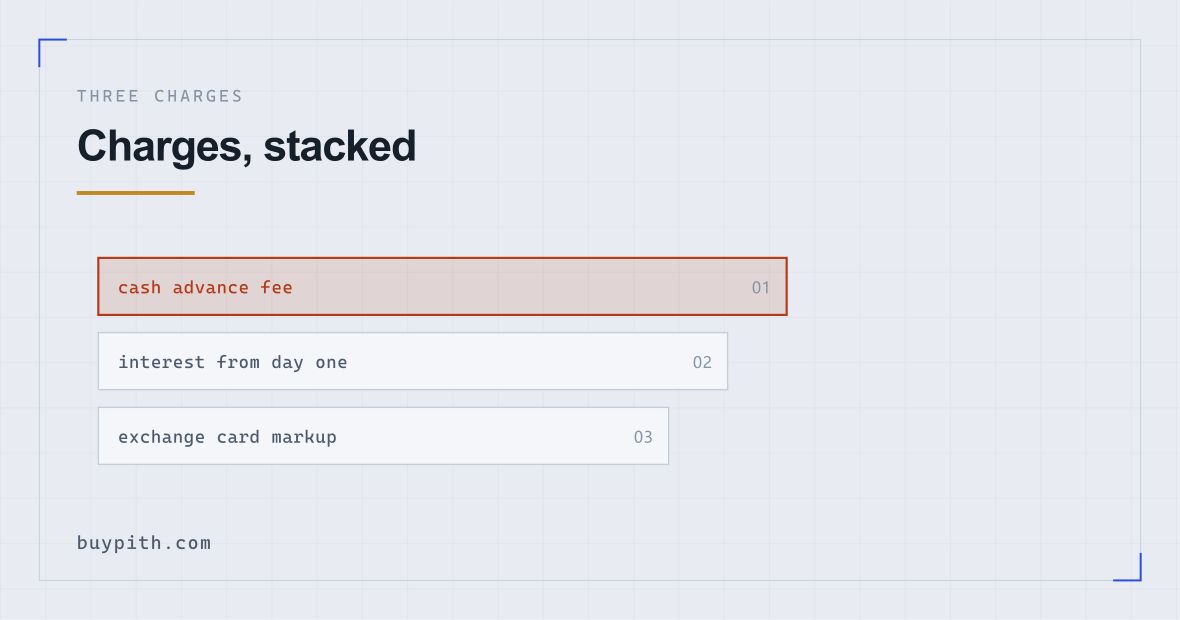
Many card issuers classify a crypto purchase as a cash advance rather than a purchase. That typically means a separate fee, a higher interest rate than your normal one, and no interest-free period — interest starts the day the transaction posts, even if you pay the statement in full. This charge comes from your bank and appears nowhere on the exchange's screen.
Whether it works at all
It depends on three parties agreeing, and any one of them can say no: the exchange has to accept credit cards in your country, your card network has to permit the merchant category, and your issuing bank has to not block it. A number of banks block crypto merchants outright as policy, and some countries prohibit credit-card crypto purchases entirely. Binance's own FAQ on failed card purchases says it weighs factors it does not make public and that repeated declines can lock the card for a period, so a decline is rarely a message about you specifically.
So a decline is common and usually has nothing to do with the exchange. The same is true of debit cards, and the fix is the same: call your issuer and ask rather than retrying.
The three charges, and who levies each
| Charge | Who takes it | Where you see it |
|---|---|---|
| Card processing markup | The exchange | On the deposit or buy screen, before you confirm |
| Cash-advance fee | Your card issuer | On your card statement, days later |
| Interest from day one | Your card issuer | On your card statement, and again next month |
The first is the one people compare when they weigh payment methods. The second and third are usually larger combined, and they are invisible at the moment of the decision because they live on a different company's screen.
Why the cash-advance classification happens
Card networks assign merchant category codes, and purchasing a financial asset that converts readily to money is not treated the same way as buying a jacket. Many issuers therefore treat it as taking cash out, and the cash-advance terms attached to most credit cards are deliberately unattractive: a fee to start, a higher rate than the purchase rate, and interest accruing immediately with no grace period.
That last detail is the one that catches people who pay their balance in full every month and have therefore never paid card interest in their lives. The grace period applies to purchases. It does not apply to cash advances.
How to find out before you do it: ask your card issuer directly whether cryptocurrency purchases are treated as cash advances, and what fee and rate apply. It is a two-minute call and the answer is specific to your card, which is why no article can tell you.
The structural problem underneath the fees
Even with all charges waived, this route would still be worth avoiding, and the reason has nothing to do with cost.
Buying a volatile asset with borrowed money means the debt does not move with the asset. If the price falls by half, the balance owed does not fall by half; it stays exactly where it was and accrues interest. You have taken a position whose downside is amplified by a fixed obligation, which is a strategy that requires being right about timing — and nobody buying their first crypto is in a position to be right about timing.
This is the reason the amount guide puts borrowed money at the top of the list of things the amount should never be. It is not a moral point. It is that a forced seller has a schedule instead of a strategy, and debt sets the schedule.
What to use instead
- Bank transfer — usually free to deposit, slower, higher limits. The default answer for a first purchase.
- Debit card — the exchange markup applies but no cash-advance charge and no interest, because it is your own money.
- Waiting — if the only available funding is credit, the useful question is not which card to use.
The payment method table puts all of them side by side with speed, cost, limits, and the ways each typically fails.
If your issuer confirms in advance that it is not treated as a cash advance, and you will clear the balance in full within the grace period, a credit card behaves like a debit card with better fraud protection. That is a real scenario. It requires checking first, not assuming — and the check is a phone call, not a search result.
Do not treat a chargeback as an exit
Credit cards come with dispute rights, and people occasionally reason that this makes a crypto purchase reversible. It does not work that way.
Crypto is treated as a delivered good. Once coins are credited, the exchange has performed its side, and a chargeback filed against a legitimate purchase is a dispute you will generally lose — after having your exchange account frozen or closed for filing it. The coins are not returned to you either. Reversibility on this path is worth understanding before you need it rather than after.
Questions people actually ask
Will my credit card definitely be charged a cash advance fee?
Not definitely — it depends on your issuer and how they classify the merchant. It is common enough that you should assume it until your issuer tells you otherwise. Ask them directly, since the answer is specific to your card and your country.
Do the credit card rewards still apply?
Usually not. Transactions classified as cash advances are typically excluded from points and cashback schemes, so the reward that made this look attractive is generally the first thing that disappears.
Why do some exchanges accept credit cards and others do not?
Chargeback exposure. Because a card payment can be disputed and a crypto transfer cannot be recalled, credit-card acceptance is a risk decision that varies by exchange, by country, and by regulation. Some jurisdictions prohibit it outright.