The answer is short. The reasons are useful.
Can I cancel a crypto purchase?
People ask this in two very different states: calmly, before buying, and urgently, thirty seconds after. The answer is the same either way, but what to do next is not.
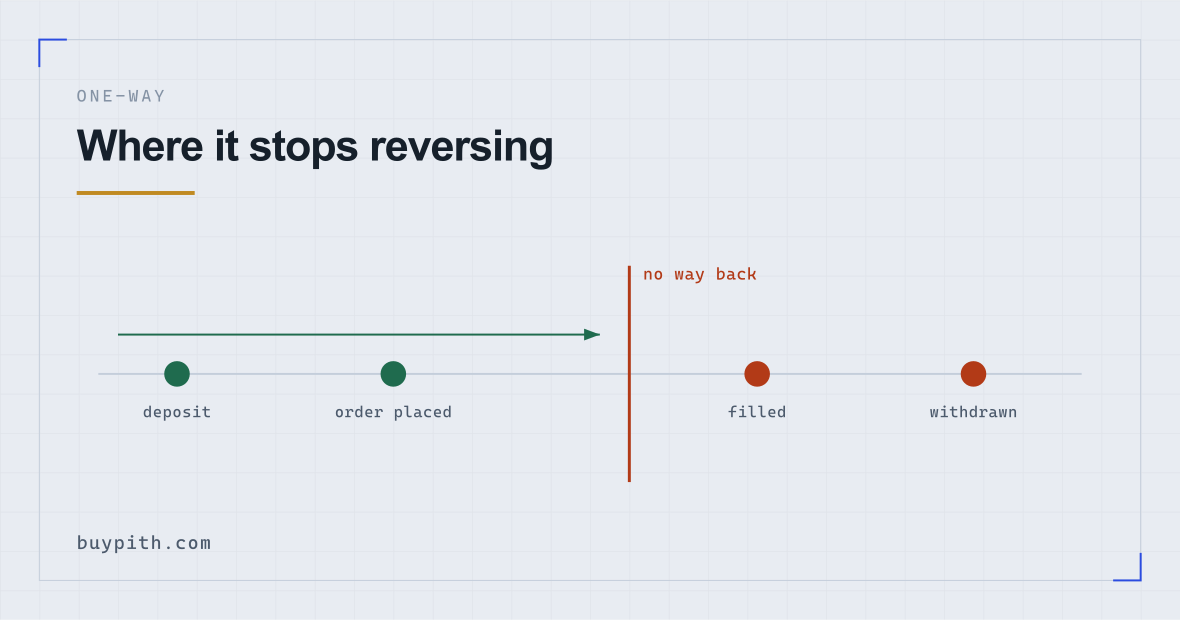
A filled order cannot be cancelled. What you can do is sell, which is a new transaction at the current price with its own fee — not a reversal. If you bought seconds ago the price will barely have moved, so selling back usually costs you the fees twice and very little else. Do that calmly, or do nothing; do not file a chargeback.
What can and cannot be cancelled
| Stage | Cancellable? | What to do |
|---|---|---|
| Bank transfer sent, not yet arrived | Sometimes | Your bank may be able to recall it if it has not settled. Ask them, quickly. |
| Money on the exchange, not yet spent | Yes | Withdraw it back to your bank account. Ordinary; some channels are free and others carry a fixed fee, shown before you confirm. |
| Limit order placed, not yet filled | Yes | Cancel it in the order screen. Costs nothing, funds are released. |
| Order partly filled | The unfilled part only | Cancel the remainder; the filled portion is done. |
| Order filled | No | Nothing to cancel. Selling is a new trade, not a reversal. |
| Coins withdrawn to a wallet | No | A confirmed blockchain transaction cannot be recalled by anyone. |
The genuinely useful line in that table is the unfilled limit order. It is the one real cancellation available to you, and it is one of the few practical arguments for using a limit order for a first purchase — alongside the fee difference.
Why a filled order does not reverse
Because there is a counterparty. Your buy matched somebody's sell, and that person now has the money and considers the matter closed. Undoing it would mean taking value back from someone who did nothing wrong. Financial markets do not have an undo button for exactly this reason, and crypto exchanges are not unusual here — a stock purchase does not reverse either.
What people are actually reaching for is the consumer-protection model they know from shopping: buy, change your mind, return it. That model exists because goods can be returned. An asset that has changed hands at an agreed price cannot.
Why a chargeback is the wrong move
Card payments feel like an escape route. In this context, filing one is close to the worst available action.
- You will usually lose the dispute. The exchange delivered what was purchased and can evidence it. Crypto is treated as a delivered good.
- Your account will likely be frozen or closed. Chargebacks are treated as fraud indicators, and platforms respond by locking the account — including any other funds sitting in it.
- The coins are not returned to you either. A successful chargeback claws money back from the exchange; it does not unwind the trade.
- It can follow you. Some platforms share fraud signals, and a chargeback against one can affect your ability to open an account elsewhere.
The one legitimate case is an unauthorised transaction — someone else used your card. That is fraud, and it is exactly what the dispute process exists for. Regret is not fraud, however strongly it is felt in the first ten minutes.
The two checks worth making while it is still possible
Cancellation is available for about as long as it takes to read a confirmation screen. Use that window for two things:
- Read the amount as a number, not a shape. A stray tap adds a zero. On a phone the confirm sheet renders it smaller than you would like, and 500 and 5000 look similar at a glance when you already know what you meant to type.
- Read the quantity you will receive, not the amount you are paying. The gap between the two is every fee combined, and if it looks larger than expected, that is the moment to find out why rather than after.
For withdrawals, the equivalent check is the address and the network. Both are unforgiving in a way the buy screen is not — a wrong address or a mismatched network usually means the funds are gone permanently.
What is genuinely recoverable, and how fast you have to move
Three situations do have a window, and in all three it is short. Knowing which one you are in decides whether to act immediately or accept it.
A bank transfer that has not settled. Some payment systems allow a recall before settlement, and instant rails generally do not. Your bank is the only party who can tell you, and the answer changes by the hour. If you sent money and immediately changed your mind, that call is worth making now rather than after the weekend.
Money sitting on the exchange, unspent. Fully recoverable: withdraw it back to your bank account. Binance lists its fiat withdrawal fees per currency and channel on its fiat fee page (opened 2026-10) — some channels are free, others charge a fixed amount shown before you confirm — and this is an ordinary operation rather than an escalation. Having deposited is not a commitment to buy.
An unfilled or partly filled limit order. Cancel it in the order screen. Reserved funds are released back to your available balance, usually within seconds. If it filled partially, the filled part is done and only the remainder cancels.
A way to undo a completed purchase. All three are about money that has not yet become crypto. Once it has, the only exit is selling, which is a new transaction at whatever the price is when you make it.
If you have already bought and regret it
Two honest options.
Sell it back. A new trade at the current price. Minutes after buying, the price has barely moved, so this costs you the fee twice and returns you to roughly where you started, minus a small amount. If holding the position is genuinely making you anxious, that is a reasonable price to pay for stopping.
Leave it and notice the reaction. If the amount was small and chosen sensibly, the discomfort you are feeling is the actual information from the exercise: it tells you the position size is above your comfort threshold, which is worth knowing and impossible to learn any other way. That does not mean holding is correct — it means the feeling is data rather than an emergency.
What is not an option is undoing it, and the sooner that is accepted the better the decision that follows. If the amount was large enough that this is genuinely distressing, that is the real signal, and the sizing question is the page to read before doing anything else.