The one page here that refuses to give you an answer
Is it too late to buy bitcoin?
This is the most-searched version of a question nobody can answer, and every confident answer you find was written by someone with a reason to want you to act. What follows is the opposite: an attempt to take the question apart until it stops being the one you need answered.
- So — is it?
- We do not know, and neither does anyone else. That is not modesty or a legal hedge; it is the accurate answer, and any site giving you a different one is telling you what it wants you to hear.
- Then why is this page here?
- Because the question is worth taking seriously even though it cannot be answered. It is usually standing in for three other questions, and those do have answers — yours.
A note on where you are reading this. This site earns money when people open exchange accounts, which gives us an obvious interest in you concluding “no, not too late” and getting on with it. Take that into account. It is also why this page exists in the form it does: the version that says plenty of room left, act now would earn more and would be a lie.
Why nobody can answer it
Answering “is it too late” requires knowing what the price will do next. Nobody does. Not analysts, not funds, not the person whose thread convinced you to search this in the first place.
The evidence for that is not a theory; it is the visible track record. Confident public predictions about this asset have been wrong in both directions, repeatedly, for well over a decade, made by people with far more resources than anyone writing a beginner guide. That does not mean the future is unknowable in some deep philosophical sense. It means that if it were knowable by the methods available to you and to us, the knowledge would already be reflected in the price.
So when you find an article confidently saying it is not too late, notice what it actually is: a person who does not know, telling you what they would like to be true, usually on a site that benefits if you act. And the articles saying you have missed it are the same thing with the opposite sign.
What the question is usually standing in for
Nobody searching this is asking for a price forecast. Under the words there are generally three different worries, and separating them is most of the work.
“Will I look stupid?”
The fear of arriving late to something everyone else understood earlier. This is a social feeling, not a financial one, and it is worth naming because it is the most powerful of the three and the one that gets people to act fastest.
It also has no financial content whatsoever. The market does not know or care when you arrived, and a purchase made to avoid feeling foolish is a purchase with no exit criteria — because the thing it was trying to fix was never about the asset.
“Am I buying at the worst possible moment?”
A real concern, and unanswerable in the way described above. What can be said is that this worry is almost always loudest after a period of rising prices, because that is when attention arrives — which is a fact about when people notice things, not a prediction about what happens next.
If the worry is genuinely about timing, the honest response is that it is not solvable, and the practical response is to make the amount small enough that being wrong about timing does not matter much. That is a decision about size, and size is entirely within your control.
“Is there anything left in it?”
This is the only version of the question that is actually about the asset, and it is a question about what you think bitcoin is for. Someone who thinks it is a long-term monetary asset and someone who thinks it is a speculative instrument that has had its run are not disagreeing about the price — they are disagreeing about the thing. Neither can be settled by an article, and both should be held with less certainty than they usually are.
Four questions that do have answers
These are answerable by you, today, without predicting anything. If you can answer all four, the original question mostly dissolves.
1. Over what period am I holding this?
Not a target price — a duration. If your honest answer is measured in weeks, you are not buying an asset, you are betting on short-term direction, which is a different activity with much worse odds for a beginner. If the answer is many years, then the question of whether you bought this month or three months from now becomes considerably less interesting.
A rough rule that costs nothing: if you might need this money within the period you just named, it should not be here.
2. What is the loss I can take without anything changing?
Not a percentage — an amount, in your own currency, that could go to zero without altering anything about your life. Write it down before you look at any prices.
Then be specific about the test: this asset has fallen by more than half from a previous high, repeatedly, and stayed down for a year or more each time. That is not a warning about a remote tail scenario; it is the ordinary behaviour of this asset within living memory. Total loss is also possible. An amount that fails that test is too large regardless of what it is, and the sizing page deals with the arithmetic side of it.
3. Why this, specifically?
If the answer is “because it went up”, that is a description of the past presented as a reason about the future. It is also the mechanism that reliably delivers new buyers at the least favourable moments — not because of anything sinister, but because rising prices generate the coverage that produces the searches.
Better answers exist. Some people hold a small position because they think the underlying idea might matter and they want a stake in it. Some hold it as a diversifier away from assets that already dominate their savings. Some are buying it to learn how it works, which is a perfectly good reason at a small size. Any of those give you something to check against later. “It went up” does not.
4. What would make me change my mind?
The most useful of the four and the one nobody asks. If nothing could make you sell and nothing could make you buy more, you do not have a position, you have an identity — and identities are expensive to maintain when they are attached to a price.
Write down, in advance, what would count as being wrong. Then, if it happens, you are executing a decision rather than reacting to a feeling at the worst possible moment.
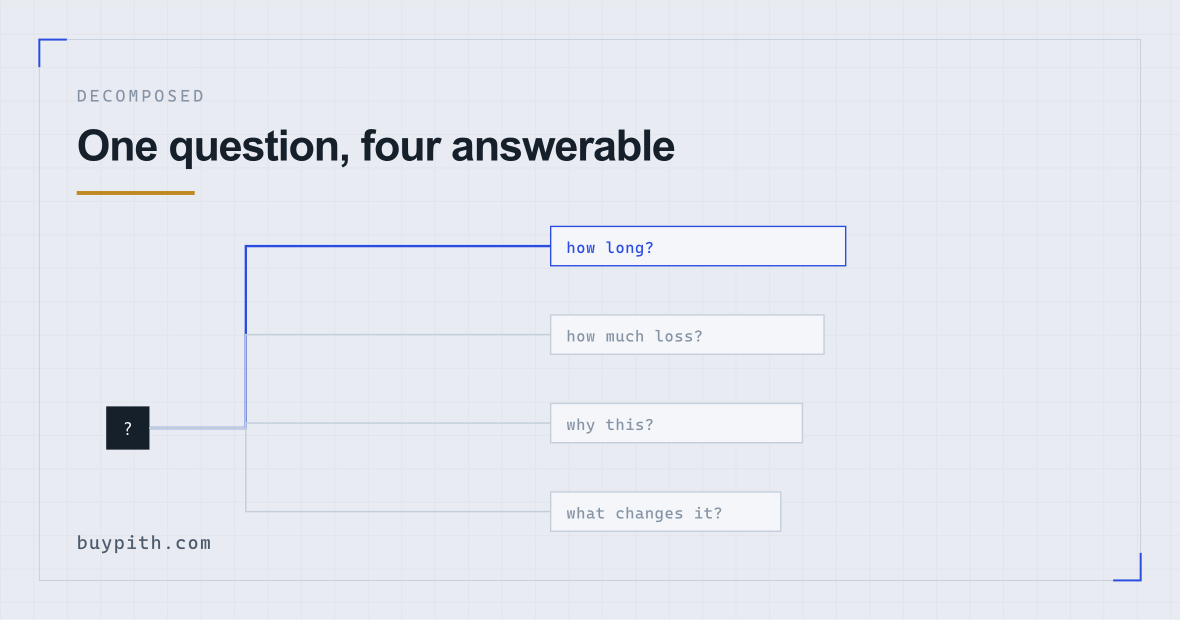
The question “is it too late” is a question about the asset. Every question that is actually decidable is about you: how long, how much, why, and what would change it. That is not a way of dodging the original — it is that the answerable questions turn out to be sufficient, and the unanswerable one turns out not to be needed.
The one thing that genuinely is time-sensitive
Nothing about the price. But there is one real deadline effect worth knowing, and it runs the other way: urgency is the tool used against you.
Every mechanism designed to extract money from new buyers — the promoted post, the group chat, the message from someone friendly, the countdown on a landing page — works by compressing the time between noticing and acting. Nothing legitimate needs you to decide today. The asset will still be purchasable next month, on the same platforms, with the same process.
So if you are feeling pressure to resolve this question quickly, that feeling is worth examining before the question is. It is not coming from the market.
And if you work through the four questions and conclude this is not for you, that is a complete answer and the tab can close. It costs nothing, which is more than can be said for the alternative.
Questions people actually ask
Has bitcoin already peaked?
Nobody knows, and we are not going to pretend otherwise. It has been declared finished many times by people with more resources than us and has been declared unstoppable just as often by people who were also wrong. Any article answering this confidently is describing a hope, not a finding.
Is it better to wait for a dip?
That is the same unanswerable question with different wording — it requires knowing what the price will do. What it does reliably produce is a state of waiting for a number that may not arrive, which is its own decision with its own cost. If the timing genuinely worries you, the controllable variable is the size of the position, not the moment.
Everyone in my group chat says now is the moment. Are they wrong?
They are not informed, which is different from wrong. A group of people expressing certainty is transmitting confidence rather than knowledge, and the loudest voices in any such group are usually the most invested. Nobody posts about the position they are down on, which makes the aggregate mood systematically misleading.